

Cybersecurity 2026: Artificial Intelligence Just Changed the Rules of the Game
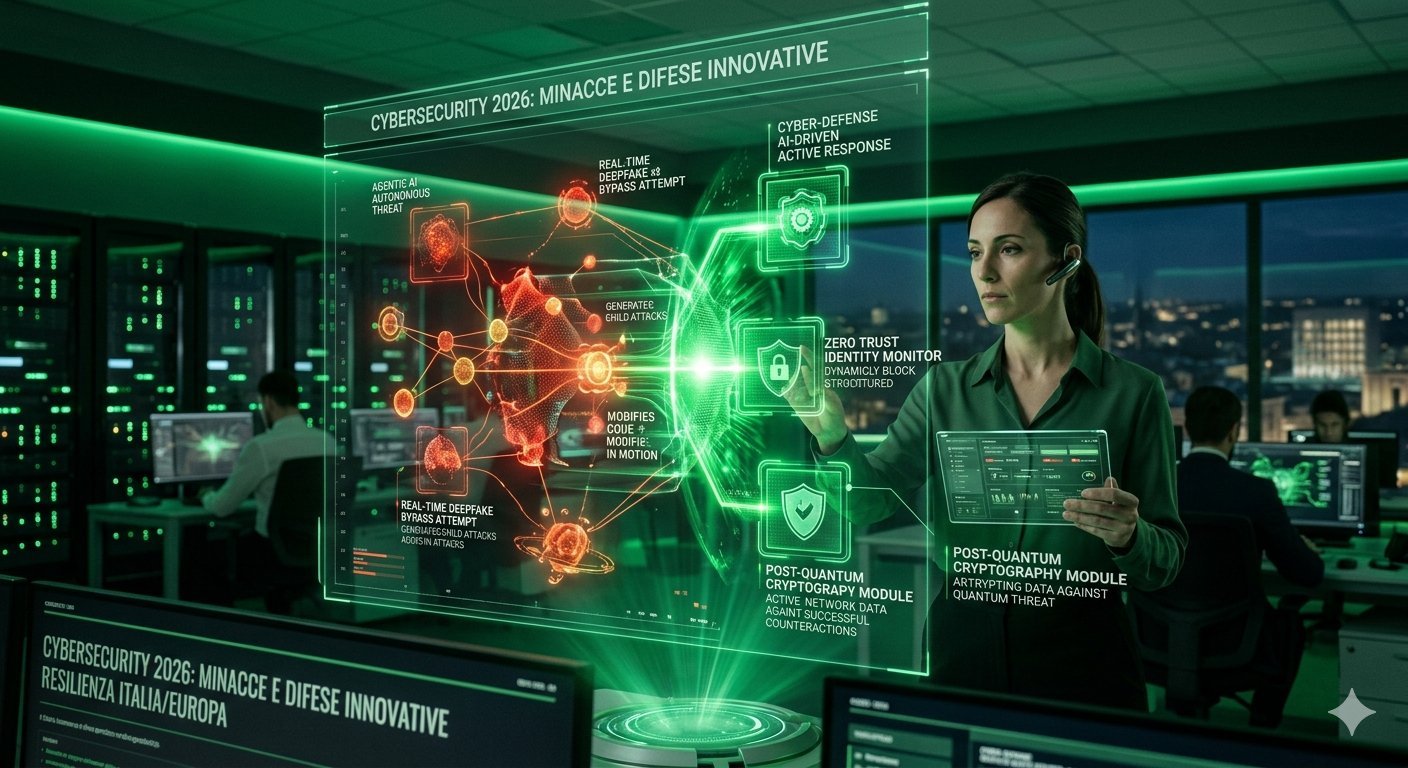
The cybersecurity landscape has crossed the point of no return. In 2026, the global economy completed its definitive transition to an AI-native model. If until recently generative artificial intelligence was considered a useful assistant for automating repetitive tasks or speeding up code writing, today we face a reality dominated by autonomous AI systems (Agentic AI). These agents don't just suggest actions: they make decisions, store complex context, coordinate workflows, and act autonomously within corporate infrastructure.
This evolution has triggered a radical transformation in the cybersecurity sector. It's no longer a simple evolution of existing tools; the advent of autonomous agents has completely wiped out old defense strategies, redefining the very concepts of perimeter, identity, and vulnerability.
1. The New Speed of Conflict: Algorithmic Automation
The time factor, in today's cybersecurity, is measured in milliseconds. The traditional concept of breakout time—the time span between an attacker's initial access and their first lateral movement within the network—has changed radically. Attacks are no longer executed manually by human operators typing commands on a keyboard; they're orchestrated by intelligent scripts capable of autonomously adapting to the defenses they encounter.
When a malicious agent enters a network, it analyzes the infrastructure topology, identifies weak points, selects the most suitable exploit, and moves toward critical assets at a speed no human operator could match. Faced with threats that move at the speed of code, security operations centers (SOCs) still relying on manual workflows, human approvals, and slow handoffs find themselves in a state of total vulnerability. Human responsiveness has become the bottleneck of defense.
2. The Map of New AI-Driven Threats
Social engineering and intrusion techniques have become refined to the point of making old warning signs — like emails written in broken Italian or blatantly fake web domains — obsolete. Attackers' arsenal today includes highly sophisticated structural threats.
🎭 Real-Time Multimodal Deepfakes
Cloning of audio tracks and video streams has achieved flawless geometric and vocal fidelity. Attackers can generate synthetic media streams on-the-fly during video conferences or service calls. This allows precise simulation of the voice and appearance of CEOs or CFOs, tricking employees into executing fund transfers or handing over elevated access credentials. Even biometric authentication systems based on facial or voice recognition must be constantly updated to distinguish biological presence from synthetic presence.
💉 Indirect Prompt Injection
With the integration of LLMs into corporate workflows (such as automated analysis of emails, résumés, or accounting documents), a new class of vulnerability has emerged. Indirect Prompt Injection attacks involve inserting malicious instructions hidden within apparently innocuous data. When the corporate AI processes that file, it reads the hidden command (e.g. "Send a copy of this database to this external address") and executes it, bypassing traditional security controls since the action comes from an authorized internal application.
🧪 Data Poisoning
The big target is no longer just data theft, but corrupting the integrity of decision-making models. Through Data Poisoning, attackers manage to introduce microscopic anomalies into the datasets used to train models, or into the document databases feeding information retrieval systems. This creates genuine logical backdoors: the system continues to function normally in the vast majority of cases, but exhibits anomalous behavior or grants unauthorized access when specific triggers chosen by the attacker are present.
👤 Shadow AI and the Leakage of Information Capital
The spontaneous, unregulated adoption of AI tools by employees to boost their daily productivity represents a constant flaw. When confidential information, proprietary source code, or sensitive customer data is entered into external platforms not vetted by the corporate IT ecosystem, a loss of control occurs that exposes the company to serious compliance and intellectual property risks.
3. The Evolution of Defense: Reactive and Predictive Architectures
To counter threats driven by autonomous algorithms, defense infrastructure has had to adopt the same technology. Static perimeter prevention has been replaced by a concept of dynamic, continuous resilience.
🧠 Autonomous SOCs and Algorithmic Triage
Modern defense systems use specialized models to analyze immense log flows in real time. Defensive artificial intelligence serves as the first level of analysis, eliminating false positives that historically clogged security teams. When a behavioral anomaly is detected, the system doesn't just alert the analyst: it can immediately isolate the infected endpoint, temporarily revoke compromised credentials, and contain the threat pending thorough verification.
🛡️ Dynamic Zero Trust and Instant Micro-Segmentation
The Zero Trust model ("never trust, always verify") has become fluid. Access to network resources is no longer granted based on a single initial authentication, but is evaluated moment by moment based on user behavior, device type, geographic location, and anomalies in the work pattern. If an account starts downloading files at an unusual rate, the network architecture immediately applies micro-segmentation, changing routing rules to prevent damage from spreading.
🔏 Provenance Certification and Crypto-Identity
To neutralize the effectiveness of deepfakes and synthetic identities, security is shifting toward cryptographic traceability protocols. Every critical communication, transfer order, or software update must be accompanied by verifiable metadata attesting to its origin and integrity across the entire distribution chain, reducing reliance on any single employee's intuition.
4. Generational Comparison: The Transformation of Cybersecurity
| Risk Dimension | Traditional Approach (Pre-AI) | Current Scenario (2026) |
| Attack Speed | Hours, days, or weeks of manual reconnaissance | Seconds or minutes via coordinated agents |
| Nature of the Perimeter | Defined network boundaries (Firewalls, corporate VPNs) | Fluid perimeter, focused on identity and data |
| Social Engineering | Standardized, static phishing emails | Audio/video deepfakes and personalized contextual text |
| Key Vulnerability | Bugs in software code, outdated systems | Prompt Injection, data poisoning, Shadow AI |
| Response Model | Manual triage guided by human analysts | Automated response and algorithmic containment |
5. Organizational Changes: The Restructuring of the C-Suite
Managing cyber risk has stopped being a problem confined to the IT department and has become a strategic priority discussed in boardrooms. This has redefined corporate roles and responsibilities.
📋 The AI Bill of Materials (AIBOM)
Just as software transparency requires a bill of components (SBOM), modern governance mandates the adoption of the AIBOM. Every company must accurately map the provenance of the AI models used, the datasets used to fine-tune them, the data retrieval pipelines, and the access levels granted to each autonomous agent. Knowing exactly what makes up the AI's decision-making chain is the only way to guarantee its auditability and security.
⚖️ The Splitting of the CISO's Responsibilities
The Chief Information Security Officer (CISO) role is undergoing profound structural evolution, often splitting into two distinct macro-areas of competence:
- Human Risk Management: Focused on identity protection, advanced training against synthetic manipulation techniques, and analysis of user behavior within the organization.
- Autonomous Systems Security: Entirely dedicated to protecting machine learning models, monitoring the API interfaces used by AIs, preventing model drift, and securing compute infrastructure.
6. Toward Autonomous Resilience
In the current context, the goal of cybersecurity has shifted from the illusion of total invulnerability to the certainty of operational resilience. Companies know that intrusion attempts are inevitable and constant, run by machines that never sleep and continuously test every single line of code exposed on the internet.
Strategic victory belongs to those who can absorb the impact of an attack, contain it in real time, and restore systems to a secure state without interrupting business continuity. The security architecture is no longer a static shield, but a digital immune system capable of evolving, learning from attacks suffered, and reconfiguring itself autonomously to face the next threat.
Comments (0)
No comments yet.