
In recent years, Large Language Models (LLMs) have transformed the way we interact with information. However, models still struggle with so-called "hallucinations" and lack up-to-date or private knowledge of company data. To solve this problem, the RAG (Retrieval-Augmented Generation) standard technique has become the norm.
But traditional RAG has a structural limit: it treats documents as isolated fragments of text. This is where GraphRAG (Knowledge Graph-based RAG) comes in, an evolved approach that combines the power of LLMs with the structured precision of Knowledge Graphs.
1. What Is GraphRAG?
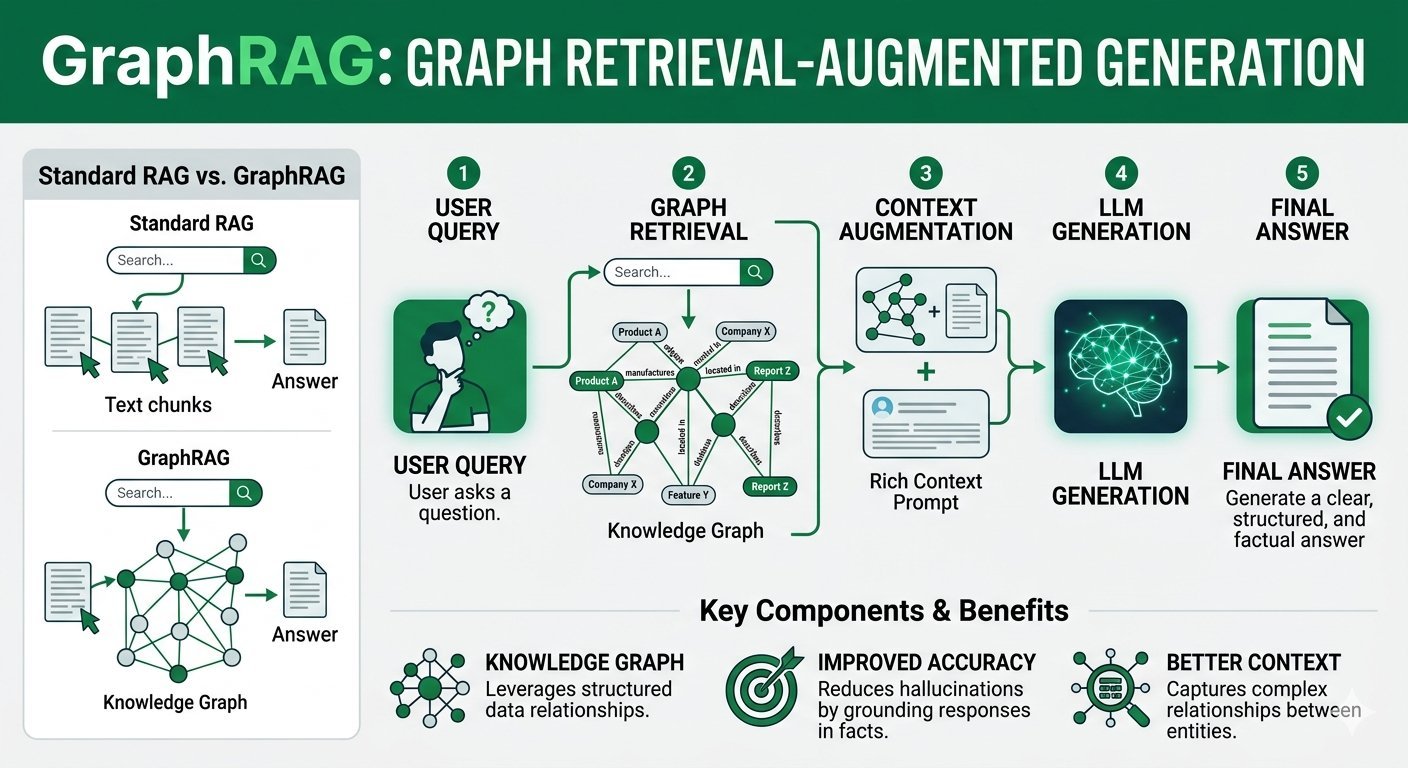
While traditional RAG relies on vector search to find text fragments similar to a query, GraphRAG extracts and links entities (people, places, concepts, objects) and their relationships within a network (a graph).
Definition: GraphRAG is an artificial intelligence architecture that enhances LLM response generation not just by retrieving relevant text, but by navigating a structured mental map (Knowledge Graph) built from the data itself.
Conceived and popularized by Microsoft research teams, GraphRAG allows the model to understand the global context and hidden connections between seemingly unrelated pieces of information.
2. The Limits of Traditional RAG (Baseline RAG)
To understand the importance of GraphRAG, we need to look at where classic RAG (based solely on Vector Search) fails:
- Lack of global vision: If you ask "What are the main themes that emerged in the financial reports of the last 5 years?", traditional RAG searches for specific text fragments. It cannot synthesize information spread across thousands of pages.
- Loss of relationships: If Document A says "Marco works for Company X" and Document B says "Company X acquired Company Y", classic RAG might not understand that Marco is indirectly linked to Company Y, unless the two texts happen to be stored close together.
- Fragmentation: Text segmentation (chunking) breaks up concepts, isolating information that should be joined together.
3. How GraphRAG Works: The Architecture
The GraphRAG process is split into two macro-phases: Indexing and Retrieval/Generation (Querying).
Phase 1: Indexing (Graph Creation)
- Source Text Chunking: Documents are split into pieces of text.
- Element Extraction: An LLM analyzes each fragment to identify all entities (e.g. Person: Elon Musk, Company: Tesla) and their relationships (e.g. Elon Musk ➔ CEO of ➔ Tesla).
- Graph Generation: These entities and relationships become nodes and edges of a graph.
- Community Detection: Network algorithms (like the Leiden algorithm) group closely related nodes into "communities" (e.g. one community for the "Automotive" sector, one for "SpaceX").
- Community Summarization: The LLM generates a summary for each individual community. This is the secret to answering global questions.
Phase 2: Retrieval and Generation (Querying)
When the user asks a question, GraphRAG can operate in two modes:
- Global Search: Uses community summaries to answer holistic questions (e.g. "What are the market trends?").
- Local Search: Navigates specific graph nodes to answer detailed questions (e.g. "Who approved the budget for project X?").
4. Direct Comparison: Baseline RAG vs. GraphRAG
| Feature | Baseline RAG (Vector) | GraphRAG (Graph + Vector) |
| Data Structure | Unconnected text fragments (Chunks) | Structured nodes, relationships, and communities |
| Question Type | Specific and pointed ("What's the price of X?") | Global and summary-based ("What risks have emerged?") |
| Context Understanding | Limited to the retrieved text fragment | Broad, based on network connections |
| Indexing Costs | Very low (only vector embeddings) | High (requires many LLM calls to extract the graph) |
| Hallucinations | Moderate (reduced compared to pure LLM) | Minimal (anchored to the graph's logical structure) |
5. Key Advantages of GraphRAG
- Multi-Hop Reasoning: Ability to connect the dots. If answering requires three separate pieces of information contained in three different files, GraphRAG follows the graph's edges and logically joins the dots.
- High-level synthesis: Unbeatable at summarizing entire datasets (thousands of PDFs, emails, or transcripts).
- Traceability and Explainability: It's possible to trace exactly the logical path taken through the graph to generate the answer, making the AI less of a "black box".
6. Enterprise Use Cases and Real-World Applications
A. Intelligence and Investigations
Analysis of court files or intelligence reports. GraphRAG can map criminal networks, suspicious financial transactions, and hidden corporate ties across millions of pages of documents.
B. Scientific and Pharmaceutical Research
Analysis of medical literature. A researcher can ask: "Are there indirect correlations between molecule X and the side effects of drug Y?". The system navigates relationships between genes, diseases, and chemical compounds.
C. Customer Support and Enterprise Search
In large companies, information is fragmented across Sharepoint, Slack, email, and Jira. GraphRAG unifies corporate knowledge, letting employees ask complex questions about internal processes.
7. Challenges and Drawbacks of GraphRAG
Despite being a revolutionary technology, GraphRAG presents some engineering and economic challenges:
- High computation costs: Building the graph requires an LLM to read the entire text to extract entities and relationships. For huge datasets, this translates into millions of tokens and significant API costs during setup.
- Implementation complexity: Managing a graph database (like Neo4j) combined with a vector database requires more advanced infrastructure skills than a simple vector RAG.
- Latency: Graph navigation and community synthesis can take longer than a simple vector search, although optimization is closing this gap.
Conclusions
Traditional RAG opened the doors to enterprise AI, but GraphRAG represents the maturity of this technology. By turning unstructured data into an interconnected knowledge network, it allows companies not just to "search" for information, but to truly understand the totality of their information assets.
As LLM model costs continue to fall, GraphRAG adoption is set to become the de-facto standard for any generative AI application requiring precision, global synthesis, and complex reasoning.
Comments (0)
No comments yet.