

Anyone developing in the world of Artificial Intelligence and LLMs sooner or later runs into the same, identical wall: context management. Tokens cost money, slow down responses, and in the more complex loops of autonomous agents tend to balloon until they saturate the context window.
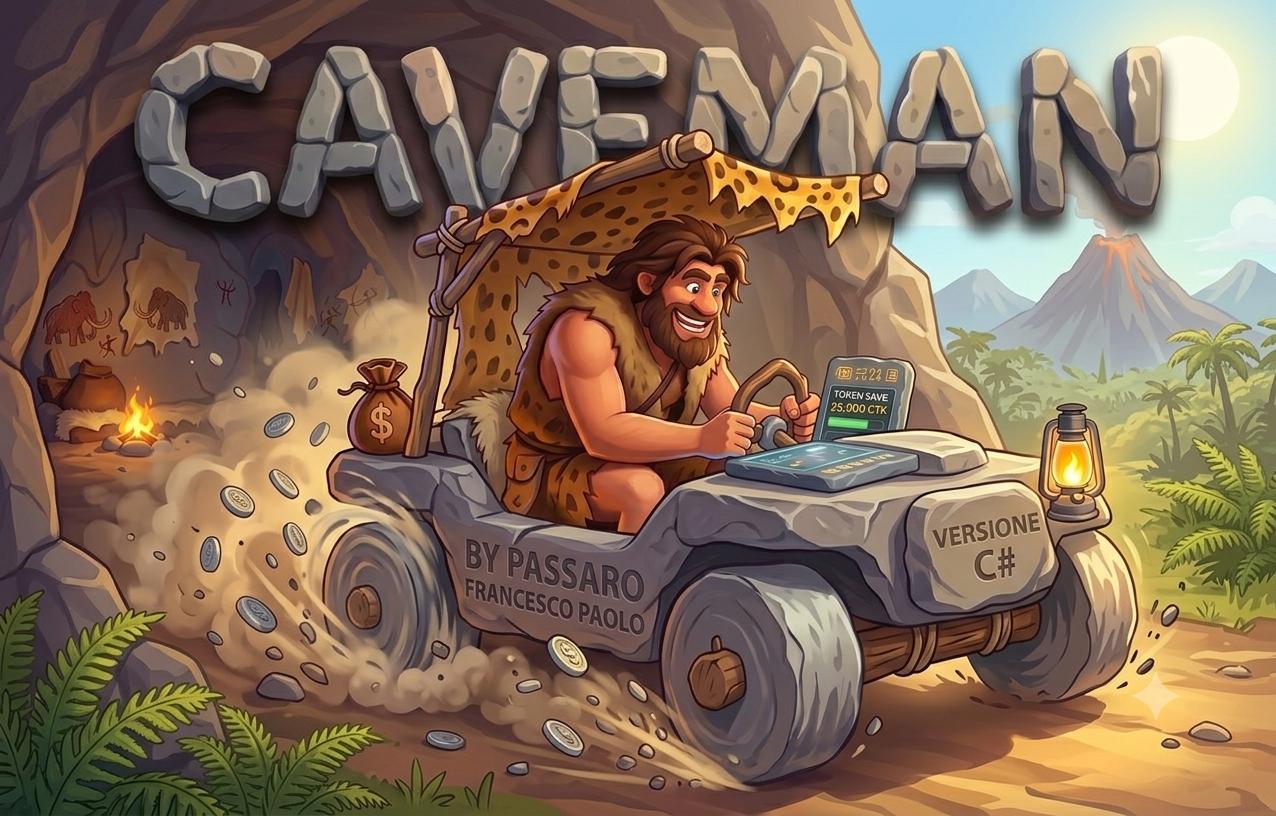
To solve this problem, a while back I started developing a project on GitHub called Caveman (a deliberately "raw" name for a task of pure brute force: putting prompts on a diet). Caveman was born in a pure .NET 8 environment, with an ambitious goal: compress text by up to 70%, locally, ultra-lightweight, and without depending on other heavy AI models.
But the real breakthrough came recently. And, as often happens in open-source, it was born from listening — and from a frantic race of parallel development.
The turning point: Caveman 1.3.0
With the release of version 1.3.0, Caveman took a quantum leap. Thanks to continuous feedback gathered in the field, the project stopped being a simple "text cleaner" (stop-words and lemmatization) and turned into an intelligent content-aware compression pipeline.
In this release we introduced three fundamental architectural pillars:
- The Content Router: A module able to autonomously understand whether the input is a JSON array, a system log, a git diff, or source code, applying vertical, targeted compression (like converting nested JSON into lossless Markdown tables on the fly).
- The Output Shaper: A system that acts on the model's responses, inserting invisible instructions into the system prompt to cut useless courtesy preambles and prevent the LLM from repeating code that was already sent.
- The Cache Aligner: Purpose-built to protect providers' (like Anthropic's or OpenAI's) KV-Cache from volatile elements that continuously invalidate the cache.
While I was optimizing these routines in C#, an overwhelming piece of evidence emerged: the community of developers actively building AI agents (using tools like Claude Code, Cursor, LangChain, or the MCP protocol) works predominantly in Python.
The potential of this technology needed to be unlocked for everyone.
The "Dual Engine": Parallel Development and Local Porting
At this point began a workflow as exhausting as it was exciting. Instead of fully completing one library and translating it months later, I decided to proceed with a mirrored, immediate porting.
The process worked like this: I'd implement a feature in C# on Caveman, test it, gather feedback, and as soon as a single local sub-version proved stable, I would immediately and in parallel update the code of the corresponding Python project.
This symbiotic approach made it possible to smooth out the flaws of both worlds. If a lemmatization dictionary for one of the over 50 supported languages showed an inefficiency in C#, the fix was injected instantly into the Python script as well. If the Circuit Breaker logic (the safety system that disables compression when it detects repeated errors) was optimized on .NET, a few minutes later it was rewritten natively and efficiently for the Python ecosystem.
From this continuous cycle of local updates and mirrored porting, Synthelion was officially born.
Synthelion: The Universal Evolution for AI Agents
Synthelion isn't just a simple Python "copy" of Caveman: it's the maturation of all the experience accumulated so far, dropped perfectly into the ecosystem where AI agents live and breathe every day.
By porting the entire content-aware architecture of Caveman 1.3.0 to Python, Synthelion can natively integrate in just a few minutes as an MCP (Model Context Protocol) server for Claude or Cursor, or as a ready-to-use plugin for LangChain and OpenAI. It keeps the same original promise: native algorithms, zero heavy AI models at runtime, native multi-language support, and that drastic cut in API costs that makes every company happy.
Open Source Is a Story of Evolution
Looking back, the journey from Caveman 1.3.0 to Synthelion reminded me why I love open-source. It's never about writing code in isolation, but about evolving ideas based on the real needs of the people who use that code. Developing these two souls in parallel, locally, one commit at a time, was an incredible challenge, but seeing an AI agent today save 70% of its tokens thanks to this architecture makes every line of code written worth it.
The repositories for both projects are entirely open. If you'd like to take a look under the hood, run a test on your own prompts, or contribute to the community, I'll see you on GitHub!
- The original C# engine: Caveman on GitHub
- The new Python ecosystem: Synthelion on GitHub
Comments (0)
No comments yet.