

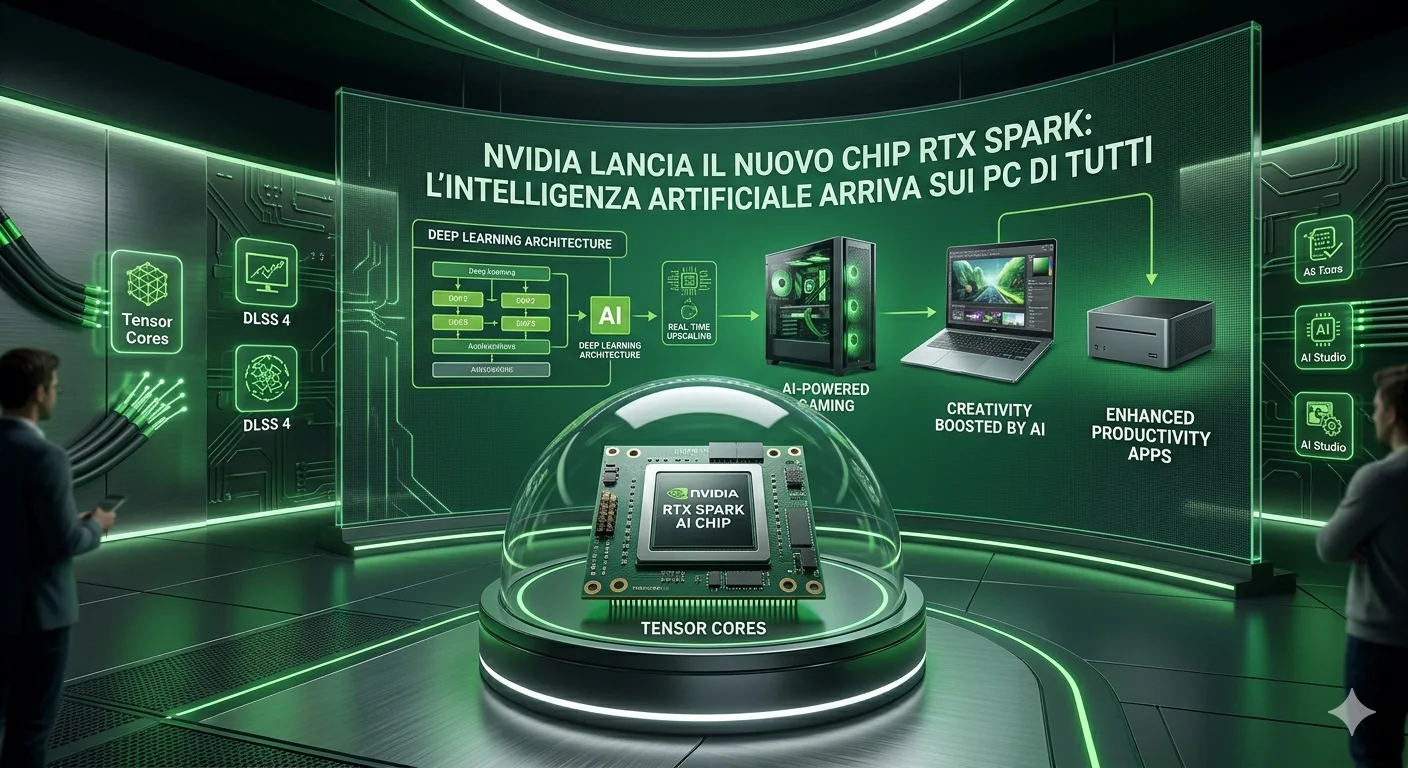
Nvidia has officially unveiled the new RTX Spark, a revolutionary processor designed to bring high-level artificial intelligence directly to personal computers. This announcement marks an important turning point in the hardware industry, because until now the most advanced AI features were almost exclusively reserved for data centers or high-end cloud services.
The RTX Spark chip integrates a completely new architecture based on fifth-generation tensor cores and ultra-fast GDDR7 memory. Thanks to this combination, the processor can run large language models, real-time image generation, and local video analysis without having to send data to external servers.
One of the main advantages is privacy. Working locally, the user retains full control over their own data, drastically reducing the risk of breaches or unauthorized use by third parties. This aspect is particularly relevant for professionals who handle sensitive information, such as lawyers, doctors, accountants, and designers.
In terms of performance, Nvidia claims an average 340% increase over the previous generation for AI workloads. As a concrete example, upscaling a 4K video that used to take several minutes can now be completed in a few seconds. Photo editing with AI tools, such as automatic object removal or text-to-content generation, also becomes extremely smooth.
The RTX Spark will initially be available on new gaming laptops and high-end workstations, but the company has already announced plans to bring it to mainstream notebooks by the end of the year. Key partners include Asus, MSI, Dell, HP, and Lenovo.
On the competitive front, this launch puts pressure on Intel and AMD, who are accelerating their own integrated AI chip projects. Even Apple, with its M-series chips, will have to contend with fiercer competition in the local AI space.
Industry experts predict that over the next 18-24 months we will witness a genuine democratization of personal AI. Students, creators, developers, and small businesses will finally be able to leverage tools once reserved only for large corporations.
However, challenges remain. The chip's power consumption is higher than traditional processors and will require more efficient cooling systems. Additionally, the price of the first devices equipped with RTX Spark will be higher than standard models, though a gradual decline is expected in the coming months.
In conclusion, the launch of RTX Spark isn't just a new product: it's the beginning of a new era in which artificial intelligence becomes an everyday companion inside our computer.
Comments (0)
No comments yet.